Tandem Concierge
You have already met this product.
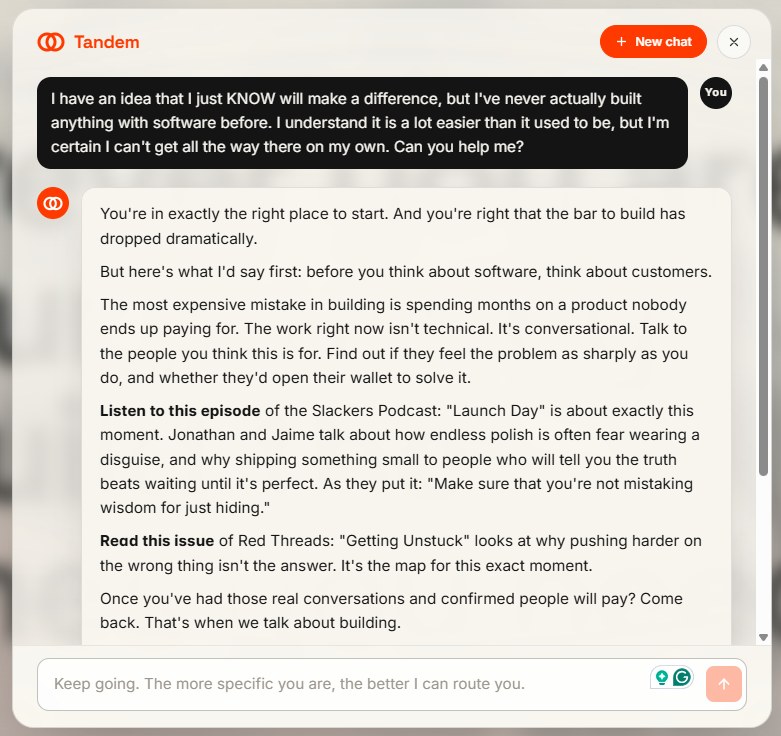
The agent on our home page is one we built for ourselves. We build the same thing for clients, on their site, in their voice. Go talk to ours, then come back and read how it works.
The problem
Most 24/7 assistants are irritating and if you're lucky, they take a message.
A lot of companies already have one. It greets, it deflects, it asks for an email, and everyone involved knows it's a way of saying, “we can't be bothered with you right now.”
The technology is not the problem. Nobody wrote down what the thing was supposed to know, how it was supposed to sound, what it was allowed to say, or what it should do when a real question showed up. So it does the only safe thing available to it, which is nothing.
What it is
The agent is the visible part.
Underneath it sits a knowledge block. That block is what we actually build, and it is the part you keep. It holds what your business has published, what it has recorded, and what the people behind it actually think. This is what the knowledge block contains:
The three highlighted pieces are the ones most builds skip.
The posture
We build these to give immediate value.
If a visitor asks something it can answer well, it answers. It does not hold the answer behind a form. It does not close every reply with a pitch. When someone is a bad fit, it says so and points them somewhere better.
That is a choice, not a default, and it is the reason ours works. We build it that way or we do not build it. If what you want is a lead form with a personality, there are cheaper places to get one.
We're a twelve person DTC brand. Revenue is flat and I think we need to rebuild the site. Can you do that?
Maybe. Two questions first. Who is the site for, and what is it for?
If traffic is flat too, a rebuild moves the furniture around a room nobody is walking into.
Traffic is fine. Conversion dropped about thirty percent since spring.
Then the site probably is not the problem, or at least not all of it. A thirty percent conversion drop against steady traffic usually means the traffic changed. Where was it coming from before spring, and where is it coming from now?
Start there before you spend a dollar on a rebuild. If the page turns out to be the real issue, we are worth a conversation. If it is the channel, we are not the right call, and I would rather say so now than in month two.
What it needs from you
Shaped by what you've already made.
A newsletter archive. A podcast back catalog. Recorded customer calls. Internal documentation. Any of it gives the agent something to be generous with.
What you get
You own all of it.
The live agent
On your site, in your voice, wired to the sources you actually have.
The knowledge block
Written and yours. Not a config file we hold. A versioned artifact you can read, edit, argue with, and hand to whoever maintains it next.
The routing
Connected to wherever your team already works, so a live conversation reaches a person the same day.
The ability to leave
If you decide in a year to rebuild it somewhere else, everything you need is in the document. That is on purpose.
We measure our success by how capable our clients become, not by how long they need us.
Where this sits
One focused build, or a whole system.
Some clients start here because the front door is visibly broken. Some arrive here inside a Jump, as one of the systems we ship across sixty days with the whole team in the room. Both start from the same place.
Scope, timeline, and price come out of one conversation, because the answer depends on what you already have.
Reach us here to get started. jump@tandemstudio.ai
Proof
Now go back and talk to ours.
You know what is under it. Ask it something hard. Ask whether we are a fit for you. Ask it to tell you when we are not.
Talk to ours